Introduction
When businesses start investing in digital marketing, one question often comes up:
Should we focus on SEO, social media, or paid advertising?
The answer isn’t the same for every business.
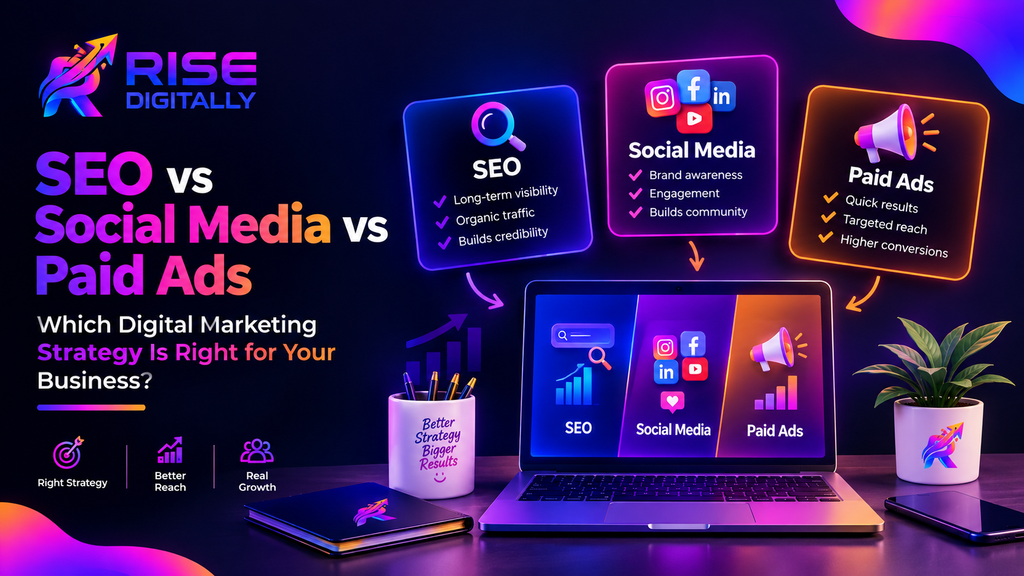
Each digital marketing channel has a different purpose. SEO can help you build long-term visibility, social media can help you connect with your audience and build a brand, while paid advertising can help you reach potential customers quickly.
The key is understanding how each strategy works and when to use it.
What Is SEO?
SEO, or Search Engine Optimization, is the process of improving your website so that it can appear more prominently in search engine results for relevant searches.
For example, imagine someone searches:
“best digital marketing agency for small businesses”
If your website is optimized for relevant searches, there is an opportunity for your business to appear in those results.
SEO generally includes:
- Keyword research
- Website optimization
- Helpful content
- Technical SEO
- Local SEO
- Internal linking
- Backlink building
- Improving website experience
Benefits of SEO
SEO is particularly valuable because it can generate organic traffic without paying for every click.
Some major benefits include:
- Long-term visibility
- Increased website traffic
- Higher brand credibility
- Better discoverability
- Potentially lower acquisition costs over time
However, SEO isn’t an overnight strategy. It requires consistency and patience.
What Is Social Media Marketing?
Social media marketing involves using platforms such as Instagram, Facebook, LinkedIn, YouTube, and others to connect with your audience.
Social media isn’t only about selling products.
It is also about building relationships.
Businesses can use social media to:
- Educate customers
- Showcase products
- Share behind-the-scenes content
- Build brand personality
- Answer questions
- Generate conversations
- Drive website traffic
- Build trust
For visually driven businesses such as fashion, jewellery, beauty, food, and lifestyle brands, social media can be especially useful.
Benefits of Social Media Marketing
Social media allows businesses to communicate directly with their audience.
It can help you:
- Increase brand awareness
- Build an engaged community
- Humanize your brand
- Showcase products and services
- Understand customer interests
- Generate leads
But social media also requires consistency. Creating one post every few weeks and expecting significant results usually isn’t enough.
What Are Paid Ads?
Paid advertising allows businesses to pay platforms to display their advertisements to specific audiences.
These advertisements can appear on search engines, social media platforms, websites, and other digital channels.
One major advantage of paid advertising is speed.
Instead of waiting for organic visibility to build, businesses can potentially reach their target audience almost immediately.
Paid advertising can be useful for:
- Product launches
- Promotions
- Lead generation
- E-commerce sales
- Event registrations
- Brand awareness
- Retargeting
However, paid advertising requires careful planning. Poor targeting, weak creative, or an ineffective landing page can result in wasted advertising spend.
SEO vs Social Media vs Paid Ads
So, which one should your business choose?
The answer depends on your objective.
| Strategy | Best For | Main Advantage |
|---|---|---|
| SEO | Long-term visibility | Organic traffic |
| Social Media | Brand building & engagement | Audience connection |
| Paid Ads | Quick reach & conversions | Immediate visibility |
Choose SEO If…
SEO may be the right priority if:
- Customers search for your products or services online
- You want sustainable organic traffic
- You are building long-term visibility
- You have useful information to publish
- You want to strengthen your website’s authority
For example, a service-based business can create informative pages and blogs targeting the questions its potential customers search for.
Choose Social Media If…
Social media may be your priority if:
- Your audience actively uses social platforms
- Your products are visually appealing
- Brand personality matters
- Community building is important
- You want regular customer interaction
Social media is particularly powerful for brands that can demonstrate their products through images, videos, Reels, stories, and educational content.
Choose Paid Ads If…
Paid advertising may be appropriate if:
- You need faster results
- You’re launching a new product
- You have a time-sensitive offer
- You want to generate leads
- You have a clear target audience
- Your website or landing page is ready to convert visitors
But remember: paid traffic cannot fix a weak offer or poor website experience.
Why You Shouldn’t Always Choose Just One
The strongest digital marketing strategies often combine these channels.
Imagine a customer discovers your brand through an Instagram Reel.
They become interested and search for your business on Google.
They visit your website and read one of your blogs.
Later, they see a paid advertisement reminding them about your service.
Finally, they contact you.
In this example, social media, SEO, your website, content, and paid advertising all contributed to the customer journey.
That’s why digital marketing should be viewed as a connected ecosystem rather than a collection of unrelated activities.
The Right Strategy Depends on Your Business
A local service business may benefit heavily from SEO and local search visibility.
An e-commerce brand may need social media combined with paid advertising.
A B2B company might focus on SEO, LinkedIn, content marketing, and lead-generation campaigns.
A startup may need a combination of brand-building and performance marketing.
There is no universal formula.
The right strategy depends on your:
- Business model
- Target audience
- Goals
- Competition
- Budget
- Products or services
- Customer journey
Final Thoughts
SEO, social media, and paid advertising aren’t competitors. They are different tools designed to achieve different marketing objectives.
SEO can build long-term visibility.
Social media can build relationships and brand awareness.
Paid advertising can accelerate reach and generate targeted traffic.
The most effective approach is to understand what your business needs and create a strategy around those needs.
At Rise Digitally, our approach is simple: digital marketing should have a clear purpose. Whether the goal is visibility, engagement, leads, or conversions, every channel should work toward meaningful business growth.
Instead of asking, “Which digital marketing channel is best?”, ask:
“Which combination of channels can help my business reach its goals?”
That is where an effective digital marketing strategy begins.