
Introduction
Getting clicks, likes, views, and followers feels good.
But are they actually helping your business grow?
In digital marketing, attention is only the beginning. The real value comes when that attention turns into meaningful actions—website visits, enquiries, leads, bookings, purchases, and eventually loyal customers.
This is why businesses should think beyond vanity metrics and focus on the complete journey from click to customer.
What Does “Clicks to Customers” Mean?
A click represents interest.
A customer represents action.
Between the two, there are several important steps.
A typical customer journey may look like this:
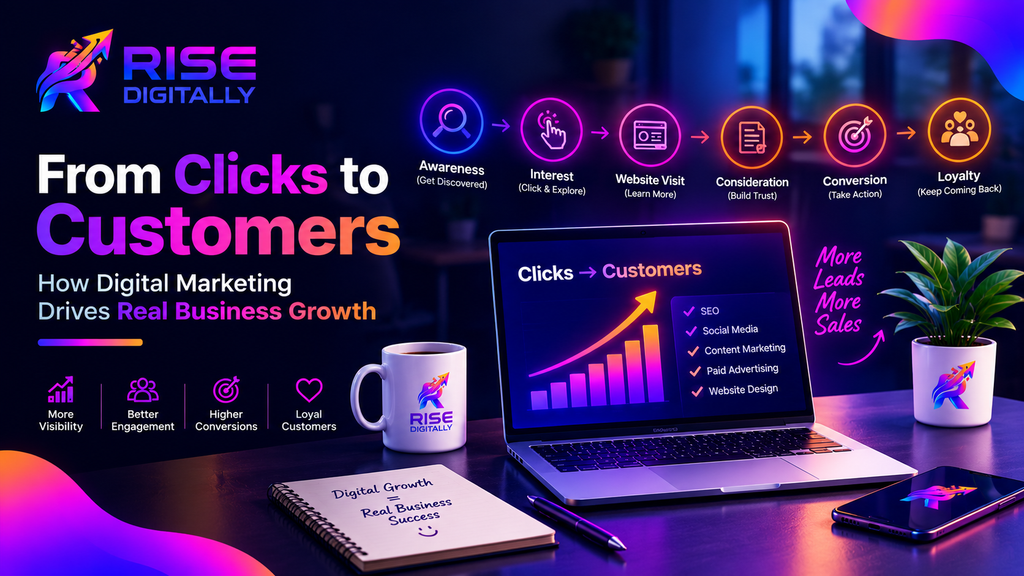
Awareness → Interest → Website Visit → Consideration → Conversion → Loyalty
Digital marketing helps businesses influence customers throughout this journey.
Let’s understand how.
Step 1: Getting Discovered
Before someone can become your customer, they need to discover your business.
This can happen through:
- Google searches
- Social media
- Online advertisements
- Blogs
- Videos
- Recommendations
- Other websites
Your first goal is therefore visibility.
For example, if someone searches for a service your business provides, appearing in relevant search results can introduce your brand to a potential customer.
This is where SEO and content marketing can play an important role.
Step 2: Creating the Right First Impression
Getting someone to your website is only half the job.
Once they arrive, they immediately begin forming an opinion about your business.
A confusing website can make visitors leave.
A professional, easy-to-use website can encourage them to explore further.
Your website should communicate three things quickly:
Who are you?
What do you offer?
Why should someone choose you?
Strong website design combines visual appeal with functionality.
Important elements include:
- Clear headlines
- Simple navigation
- Mobile responsiveness
- Fast loading
- Strong visuals
- Relevant information
- Testimonials
- Clear calls-to-action
The goal isn’t simply to make the website look good.
The goal is to make it work.
Step 3: Building Trust
Customers rarely make decisions based only on one advertisement.
They often research before purchasing.
They may check your website, social media profiles, reviews, testimonials, previous work, and online presence.
This is why consistent branding matters.
Your business should present a clear and trustworthy image across different digital platforms.
Content can also help establish credibility.
Instead of constantly saying, “We are the best,” demonstrate your expertise.
Share:
- Helpful tips
- Industry insights
- Educational blogs
- Case studies
- FAQs
- Customer experiences
- Behind-the-scenes content
When you consistently provide value, customers have more reasons to trust your business.
Step 4: Turning Visitors Into Leads
Getting website traffic doesn’t automatically generate business.
Your website needs clear opportunities for visitors to take action.
Depending on your business, this could be:
- Contact us
- Book a consultation
- Request a quote
- Buy now
- Call us
- Send an enquiry
- Subscribe
- Download a resource
These are called calls-to-action, or CTAs.
A strong CTA tells the visitor exactly what to do next.
For example, instead of a vague button saying “Submit,” a service business might use:
“Get Your Free Consultation”
The clearer the next step, the easier it is for users to take action.
Step 5: Using Paid Advertising Strategically
Paid advertising can help bring targeted visitors to your website.
But the advertisement itself isn’t the entire strategy.
Imagine you run an advertisement promoting your service. A potential customer clicks it but lands on a generic homepage where they cannot immediately understand what to do next.
That click may be wasted.
A better approach is to create a relevant landing experience that matches the advertisement.
If the ad promotes a particular service, the landing page should focus on that service.
This creates consistency between:
Ad → Landing Page → Offer → CTA
The smoother this journey is, the better the opportunity for conversion.
Step 6: Measuring What Actually Matters
One of the biggest advantages of digital marketing is measurability.
You can track what happens after someone interacts with your marketing.
Instead of focusing only on likes or impressions, businesses should also monitor:
- Leads generated
- Cost per lead
- Conversion rate
- Website enquiries
- Sales
- Customer acquisition cost
- Return on advertising spend
For example, suppose Campaign A receives 10,000 views and generates five leads.
Campaign B receives 3,000 views but generates 30 leads.
Campaign B may be much more valuable to the business even though it received fewer views.
This is why numbers need context.
Step 7: Turning Customers Into Repeat Customers
Digital marketing shouldn’t stop after the first purchase.
Existing customers can become some of your most valuable brand advocates.
Businesses can maintain relationships through:
- Email marketing
- Social media
- Loyalty programs
- Helpful content
- Special offers
- Customer support
- Personalized communication
A satisfied customer can also recommend your business to others.
In this way, one customer can potentially create additional growth.
The Power of an Integrated Digital Strategy
The biggest mistake businesses make is treating every marketing channel separately.
Your website, SEO, social media, content, and paid advertisements should support each other.
Think of your digital presence as a system.
SEO brings visibility.
Social media builds engagement.
Content builds trust.
Your website provides information and converts visitors.
Paid advertising accelerates targeted reach.
Analytics tells you what is working.
When these elements work together, digital marketing becomes more than simply generating traffic.
It becomes a growth engine.
Focus on Business Outcomes, Not Just Online Attention
Digital marketing has changed the way businesses reach customers.
But one principle remains important:
Attention is valuable only when it leads somewhere.
A thousand clicks mean very little if nobody takes the next step.
A smaller number of highly relevant visitors can be far more valuable if they become customers.
That’s why businesses should focus on attracting the right audience, creating a strong digital experience, building trust, and making the path to conversion simple.
Final Thoughts
The journey from clicks to customers doesn’t happen by accident.
It requires strategy.
From the first Google search or social media interaction to the final purchase or enquiry, every digital touchpoint can influence a customer’s decision.
At Rise Digitally, we believe digital marketing should be focused on real growth—not just numbers on a dashboard.
Because the ultimate goal isn’t simply to get more clicks.
It’s to turn the right clicks into the right customers.