
Introduction
In today’s competitive digital world, having an online presence is no longer optional for businesses. Whether you run a small local business, an e-commerce brand, a startup, or an established company, your customers are already searching for businesses like yours online.
But simply being online is not enough.
Many businesses invest time and money into websites, social media, advertisements, and content but still struggle to generate consistent leads and sales. Often, the problem isn’t the lack of effort—it’s the mistakes being made along the way.
Here are seven common digital marketing mistakes that could be holding your business back and what you can do about them.
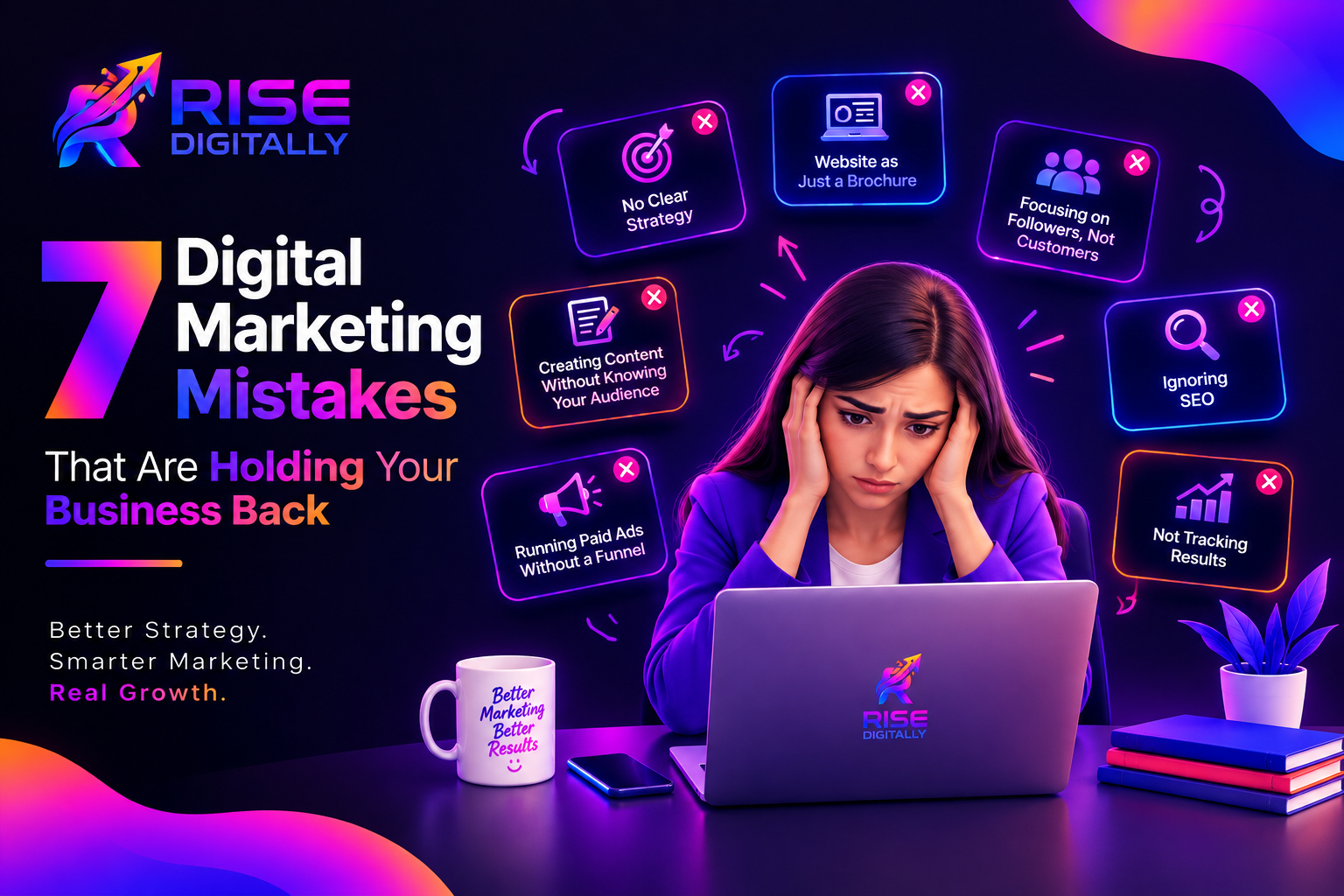
1. Not Having a Clear Digital Marketing Strategy
One of the biggest mistakes businesses make is jumping into digital marketing without a proper strategy.
Posting randomly on Instagram, running occasional advertisements, or creating a website without defining clear goals can make your marketing efforts inconsistent.
Before starting any campaign, ask yourself:
- Who is my target audience?
- What problem does my business solve?
- What do I want to achieve?
- Which platforms does my audience use?
- How will I measure success?
Your strategy should connect your business goals with the right digital channels.
For example, a local business may benefit from local SEO and Google visibility, while an e-commerce brand may need a combination of social media marketing, paid advertising, SEO, and conversion-focused website design.
2. Treating Your Website Like Just an Online Brochure
Your website is often the first major interaction a potential customer has with your business.
Unfortunately, many businesses create a website and then leave it untouched for years.
A good website should do more than display information. It should guide visitors toward taking action.
Your website should have:
- Clear navigation
- Mobile-friendly design
- Fast loading speed
- Strong and relevant content
- Clear calls-to-action
- Easy-to-find contact information
- Trust-building elements such as testimonials or reviews
A beautiful website that doesn’t generate enquiries isn’t doing its full job.
Your website should work as a part of your marketing system—not as a separate digital asset.
3. Focusing on Followers Instead of Customers
Having thousands of followers may look impressive, but followers alone don’t necessarily grow a business.
The real question is:
Are your online efforts attracting the right people?
A business with 2,000 highly relevant followers can potentially generate better results than one with 50,000 inactive or unrelated followers.
Instead of focusing only on follower growth, track meaningful metrics such as:
- Website traffic
- Leads
- Enquiries
- Conversion rate
- Sales
- Customer engagement
- Return on advertising spend
Your goal should be to build an audience that is interested in your products or services and is capable of becoming a customer.
4. Ignoring SEO
People use search engines every day to find products, services, answers, and businesses.
If your website doesn’t appear when potential customers search for relevant terms, you may be missing valuable opportunities.
Search Engine Optimization (SEO) helps improve your website’s visibility in search results.
But SEO isn’t simply about adding keywords to a page.
Effective SEO includes:
- Keyword research
- Helpful content
- On-page optimization
- Technical SEO
- Internal linking
- Local SEO
- Website performance
- Quality backlinks
SEO also takes time. Businesses sometimes stop their SEO efforts because they don’t see immediate results.
Instead, think of SEO as a long-term investment in your online visibility.
5. Creating Content Without Understanding Your Audience
Content marketing is everywhere, but creating content just for the sake of posting isn’t enough.
Your content should answer a question, solve a problem, educate your audience, entertain them, or help them make a decision.
Before creating content, understand:
What does my customer actually want to know?
For example, instead of a jewellery brand repeatedly posting product photos, it could create content such as:
- How to choose jewellery for different occasions
- Jewellery styling tips
- Buying guides
- Jewellery care tips
- Frequently asked questions
Useful content gives people a reason to follow your brand and eventually trust your business.
6. Running Paid Ads Without a Proper Funnel
Paid advertising can generate quick visibility, but simply boosting a post or sending everyone to your homepage isn’t always an effective strategy.
Successful advertising usually requires a clear customer journey.
A potential customer might go through several stages:
Awareness → Interest → Consideration → Conversion
Your advertising strategy should reflect these stages.
For example, you could use educational content to introduce your brand, retarget interested visitors with relevant offers, and then direct high-intent users toward a product page or enquiry form.
Most importantly, don’t judge an advertising campaign only by clicks.
Look at whether those clicks are turning into meaningful actions.
7. Not Tracking Your Results
One of the biggest digital marketing mistakes is making decisions based on assumptions rather than data.
Without tracking, you may not know which campaigns are working or where your customers are coming from.
Track metrics that are relevant to your business goals.
For a website, you might monitor:
- Visitors
- Traffic sources
- Popular pages
- Leads
- Conversion rate
For social media:
- Reach
- Engagement
- Saves
- Shares
- Profile visits
- Website clicks
For paid advertising:
- Cost per click
- Cost per lead
- Conversion rate
- Return on ad spend
Data helps you understand what’s working and what needs improvement.
How to Avoid These Mistakes
Digital marketing works best when different channels work together.
Your website should support your SEO strategy. Your content should support your social media strategy. Your advertising should support your conversion goals.
Instead of asking, “What should we post today?” start asking:
“What are we trying to achieve, and how can digital marketing help us achieve it?”
That shift can make your marketing much more effective.
Final Thoughts
Digital marketing isn’t about being everywhere. It’s about being in the right places, reaching the right audience, and communicating the right message consistently.
Avoiding these seven mistakes can help your business build a stronger online presence, attract better-quality leads, and create a more sustainable digital growth strategy.
At Rise Digitally, we believe digital marketing should go beyond likes and impressions. Every website, campaign, and piece of content should have a purpose: helping businesses build visibility, connect with customers, and grow.
The digital landscape keeps changing—but with the right strategy, your business can grow with it.