
When businesses want more website traffic, qualified leads, and sales, two strategies often enter the conversation: paid advertising and search engine optimization. The debate around Google Ads vs SEO matters because both approaches can improve visibility in search results, but they work in very different ways.
Google Ads can put a business in front of potential customers quickly, while SEO focuses on earning organic visibility over time. Understanding the difference can help business owners choose a strategy based on goals, budget, competition, audience, and timeline.
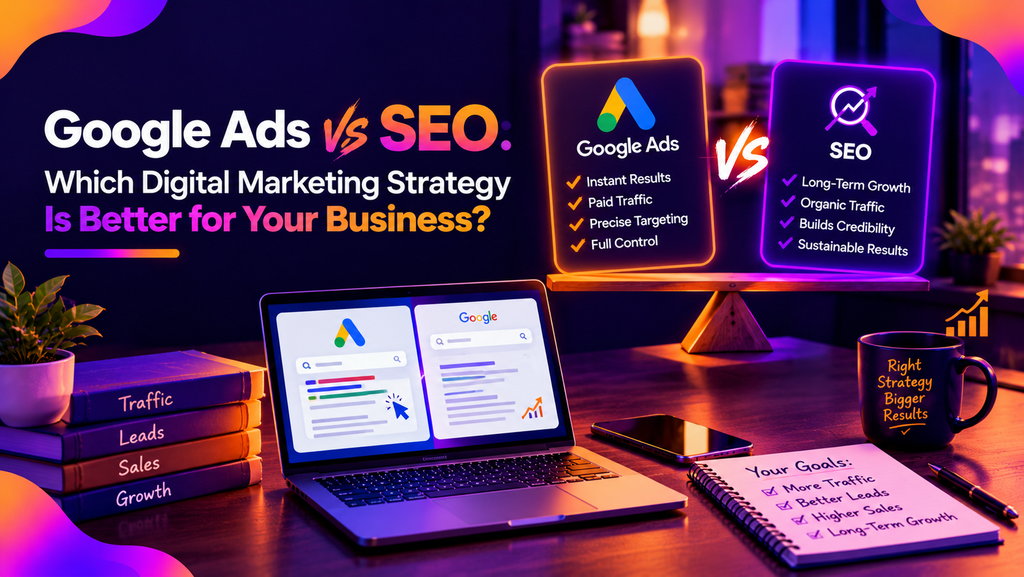
What Is Google Ads?
Google Ads is a paid advertising platform that allows businesses to show advertisements when people search for relevant products or services. Advertisers usually pay when users interact with their ads, depending on the campaign type and bidding model.
In the Google Ads vs SEO discussion, paid advertising is generally associated with speed, targeting, and measurable campaign control. Once a campaign is approved and properly configured, ads can begin appearing for relevant searches.
Businesses can target keywords, locations, audiences, devices, schedules, and other campaign settings. This makes Google Ads useful for promoting offers, generating leads, launching products, testing messages, or reaching customers during important periods.
What Is SEO?
Search engine optimization is the process of improving a website so search engines can understand its content and users can discover it through unpaid organic results.
When comparing Google Ads vs SEO, SEO is generally considered a longer-term strategy. It includes keyword research, technical optimization, content creation, internal linking, local optimization, website improvements, and authority building.
Unlike paid advertising, businesses do not pay Google for every organic click. However, SEO still requires investment in expertise, content, development, tools, research, and continuous optimization. Results can also take time, especially in competitive industries.
Google Ads vs SEO: Speed of Results
One of the clearest differences between the two approaches is how quickly they can generate visibility.
Google Ads can provide exposure soon after campaigns become active. This can be useful when a business needs immediate traffic, has a limited-time offer, or wants to generate inquiries quickly.
SEO usually takes longer because search engines need time to discover, evaluate, and rank pages. The timeline depends on competition, website authority, content quality, technical health, search demand, and the consistency of optimization.
Therefore, Google Ads vs SEO is not simply a choice between fast and slow marketing. It is a decision about immediate visibility compared with building organic search presence over time.
Google Ads vs SEO: Cost Considerations
Budget is another major factor. Google Ads requires an advertising budget, and costs can vary according to competition, keywords, targeting, bidding, campaign quality, and demand.
SEO does not normally require paying for every organic visit, but it still involves costs. Businesses may need SEO professionals, writers, developers, software, analytics tools, and ongoing content production.
In the Google Ads vs SEO comparison, businesses should consider total investment rather than looking only at the price of a click. Paid campaigns spend directly on traffic, while SEO invests resources into improving a website and its organic visibility.
Google Ads vs SEO: Long-Term Value
Paid advertising generally produces traffic while campaigns are active. When spending stops, the immediate flow of paid visitors can decline.
SEO can create longer-term value because optimized pages may continue attracting visitors after the initial work is completed. However, rankings are not permanent. Competitors can improve, search behavior can change, and search engines can update their systems.
This makes Google Ads vs SEO an important discussion for businesses thinking about both immediate performance and sustainable visibility. A strong SEO foundation can support future traffic, while paid campaigns can help meet short-term goals.
Google Ads vs SEO: Targeting and Control
Google Ads offers detailed campaign control. Businesses can set budgets, locations, schedules, audiences, keywords, advertisements, and landing pages. Campaign performance can also be monitored and adjusted based on data.
SEO provides less direct control over exactly when and where a page appears in organic results. Search engines determine rankings using many signals related to relevance, content, quality, authority, and user experience.
For businesses considering Google Ads vs SEO, this distinction is important. Paid search provides greater control over campaign delivery, while SEO focuses on earning visibility through useful content and a strong website.
Google Ads vs SEO: Which Can Generate More Leads?
Both strategies can generate leads, but performance depends on the industry, offer, audience, competition, landing page, and execution.
Google Ads can be useful when customers have strong purchase intent and the business wants to reach them immediately. SEO can attract people at different stages of the buying journey, including users researching questions, comparing options, and looking for solutions.
Instead of treating Google Ads vs SEO as an either-or decision, businesses can consider how each channel supports different customer journeys. Tracking conversions is essential for understanding which approach produces meaningful business results.
Can You Use Google Ads and SEO Together?
Yes. Many businesses can use both approaches as complementary parts of a broader search strategy.
Google Ads can provide immediate traffic while SEO works toward stronger organic visibility. Paid campaign data can reveal useful information about search terms, messaging, audiences, and offers. These insights can help inform future SEO content and landing pages.
At the same time, well-optimized organic content can strengthen the overall website experience. This means Google Ads vs SEO does not always require choosing only one channel. A combined strategy may allow businesses to address both short-term and long-term marketing objectives.
When Should Your Business Use Google Ads?
Google Ads may be useful when your business:
- Needs traffic or leads quickly
- Has a time-sensitive promotion
- Is launching a new product or service
- Wants to test keywords or offers
- Needs precise location or audience targeting
- Has a defined advertising budget
Paid search can provide a practical way to reach relevant users when timing and control are important.
When Should Your Business Invest in SEO?
SEO may be valuable when your business:
- Wants sustainable organic visibility
- Needs long-term website traffic
- Wants to build topical authority
- Publishes educational or informational content
- Wants to reduce dependence on paid traffic
- Can invest consistently over time
The Google Ads vs SEO decision should reflect your business stage, customer behavior, resources, and marketing objectives rather than a universal formula.
How to Choose the Right Strategy
Before selecting an approach, consider your goals, budget, competition, audience, customer journey, website condition, and expected timeline.
If your priority is immediate visibility, paid search can play an important role. If your goal is long-term organic growth, SEO may deserve greater attention. Businesses with enough resources can combine both approaches and measure the results separately.
The most useful way to evaluate Google Ads vs SEO is to ask what your business needs today and what kind of digital presence you want to build over the next several years.
Final Thoughts
Google Ads and SEO are different marketing tools, but both can contribute to business growth when used strategically. Paid search can provide faster visibility, precise targeting, and campaign control. SEO can help build organic visibility, useful content, credibility, and long-term search presence.
There is no universal strategy that works exactly the same for every business. The right mix depends on industry, audience, competition, budget, website quality, sales cycle, and goals.
Ultimately, Google Ads vs SEO should be viewed as a strategic comparison rather than a simple competition. Understanding how both channels work allows businesses to allocate resources more carefully, measure meaningful outcomes, and build a digital marketing strategy that supports both immediate opportunities and sustainable growth.