
Small businesses often compete with larger brands, but local search creates an opportunity to connect with customers who are actively looking for nearby products or services. With the right strategy, businesses can reach people ready to call, visit, book, or buy.
For many owners, local SEO for small businesses is not complicated technical work. It is about making business information accurate, useful, trustworthy, and easy to understand. A clear strategy can turn local searches into calls, visits, bookings, and sales today.
What Is Local SEO?
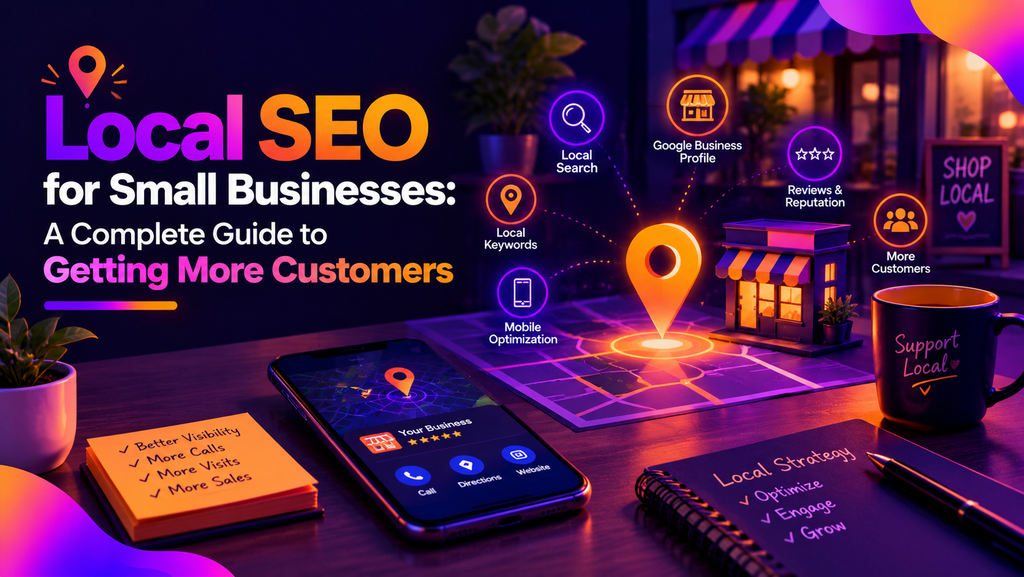
Local SEO improves a business’s online presence for searches connected to a specific location. When someone searches for “digital marketing agency near me” or “best café in Delhi,” search engines use location and relevance to provide useful results.
The goal of local SEO for small businesses is to connect your company with customers in the areas you actually serve. It is especially valuable for shops, restaurants, clinics, professional services, and home-service providers.
Why Local SEO Matters for Small Businesses
One major advantage of local SEO for small businesses is reaching people with strong purchase intent. Someone searching for a nearby service may already know what they need and be comparing options.
Local visibility can also build trust through your business name, location, hours, reviews, photos, website, and contact information. Proper optimization can continue bringing visibility, making local search useful for long-term marketing.
1. Optimize Your Google Business Profile
local SEO for small businesses
A complete Google Business Profile should be the foundation of local SEO for small businesses. Make sure your business name, address, phone number, website, category, hours, and service information are accurate and consistent.
Add quality photographs and update the profile when information changes. Choose relevant categories and keep services accurate. Share updates where useful, answer questions, and respond professionally to reviews.
2. Keep Business Information Consistent
local SEO for small businesses
Search engines use information from different online sources to understand a business. Different names, addresses, or phone numbers across listings can create confusion.
A key part of local SEO for small businesses is maintaining consistent information across your website, Google profile, social pages, directories, and industry listings. Correct outdated details after any business change.
3. Create Location-Focused Website Content
local SEO for small businesses
Your website should clearly communicate where you operate and what you offer. Create location pages only for areas you genuinely serve.
For effective local SEO for small businesses, include service areas naturally in titles, headings, descriptions, and useful content. Explain what local customers can expect and provide clear contact options.
Avoid repeating city names unnaturally. Write for people first.
4. Build Reviews and Manage Reputation
local SEO for small businesses
Customer reviews can influence trust and local visibility. Encourage genuine customers to share experiences after purchasing.
Reviews are an important part of local SEO for small businesses because they reflect real customer experiences. Respond to feedback professionally, and never buy fake reviews or create misleading testimonials.
5. Make Your Website Mobile-Friendly
local SEO for small businesses
Many local searches happen on smartphones, so a slow or difficult mobile website can lose customers.
Mobile optimization is essential to local SEO for small businesses. Pages should load efficiently, text should be readable, and buttons should be easy to tap. Make phone numbers, directions, contact forms, services, and booking options easy to find.
6. Use Local Keywords Naturally
Keyword research helps you understand how customers describe products and services. Instead of repeating one phrase, use related terms that reflect real searches.
For local SEO for small businesses, consider service-plus-location phrases, neighborhood terms, questions, and conversational searches. Use keywords naturally in headings, page copy, image descriptions, and metadata. The goal is relevance, not repetition.
7. Earn Relevant Local Links
Links from reputable local websites can support online authority. Consider local organizations, industry associations, community publications, chambers of commerce, and complementary businesses.
A strong local SEO for small businesses strategy focuses on relevant relationships rather than collecting links. Useful, trustworthy references are more valuable than low-quality links.
8. Create Helpful Local Content
Local content can help your business become a useful community resource. Publish guides, FAQs, tips, comparisons, or practical advice connected to your services.
For local SEO for small businesses, answer questions customers actually ask, such as how to choose a provider, prepare for a service, or understand pricing. Avoid thin articles created only to target locations.
9. Track Performance and Improve
SEO is not a one-time task. Monitor Google Business Profile performance, website traffic, search queries, calls, leads, and conversions.
Tracking helps you understand which parts of local SEO for small businesses produce meaningful results. Improve pages that receive visibility but few inquiries, and review performance regularly.
10. Avoid Common Local SEO Mistakes
Common mistakes include inaccurate business information, duplicate location pages, ignored reviews, keyword stuffing, low-quality links, and incomplete Google Business Profiles.
Another mistake is expecting immediate results. Local visibility can take time, especially in competitive markets. Consistent optimization and customer-focused improvements are more sustainable than shortcuts.
A Practical Strategy for 2026
The future of local search is increasingly focused on relevance, trust, convenience, and user experience. Businesses should think beyond rankings and consider the complete customer journey.
When someone discovers your business, they should quickly understand what you offer, where you operate, why customers trust you, and how to take the next step. This customer-first approach makes local SEO for small businesses more effective.
Start with your business profile, online information, website, reviews, local content, and performance tracking. Continue refining each area based on customer behavior.
Conclusion
Local SEO can give small businesses a practical way to compete for attention in their communities. You do not need an enormous advertising budget; you need accurate information, a trustworthy online presence, useful content, positive customer experiences, and consistent optimization.
When implemented thoughtfully, local SEO for small businesses can attract qualified customers and connect online searches with real-world actions. Start with the fundamentals, measure what matters, and keep improving.